Why Your Best People Leave Without Warning
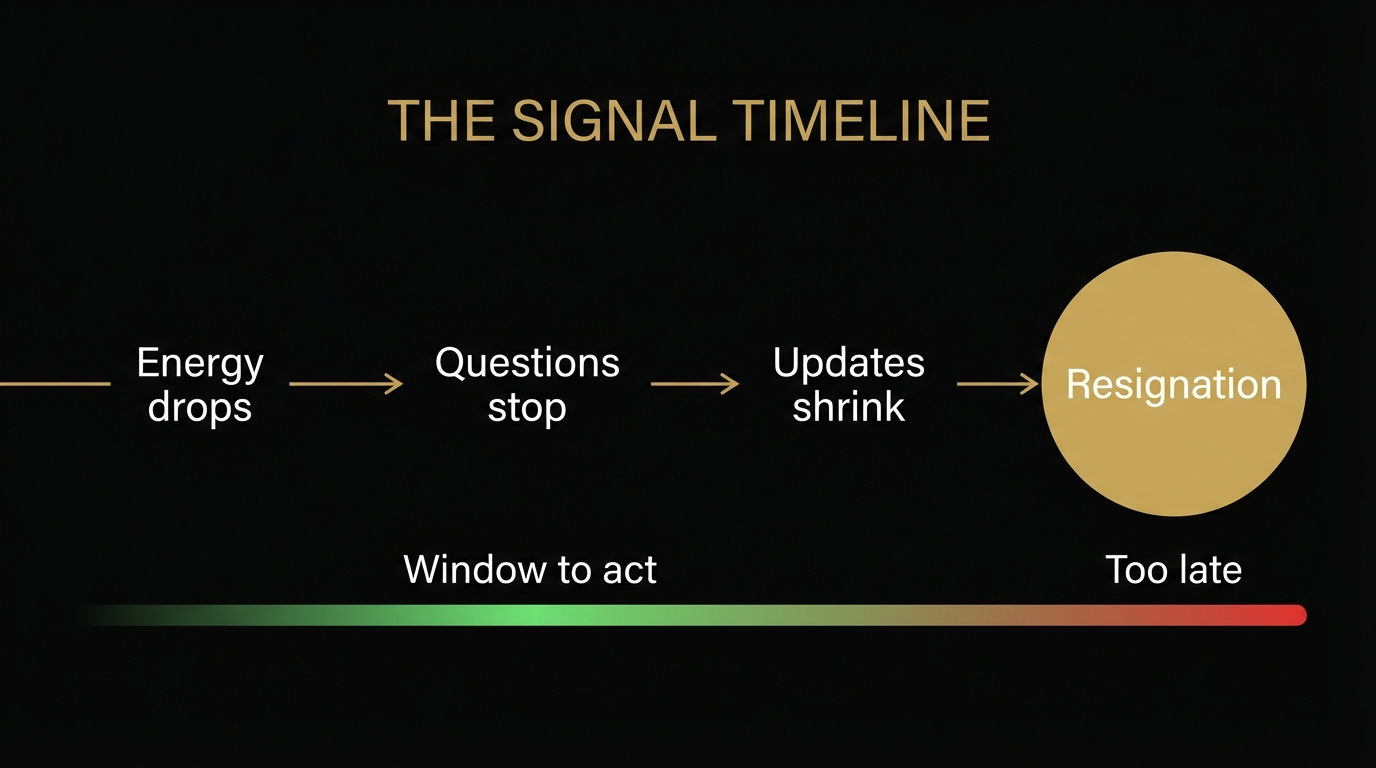
Here’s something I learned the expensive way: your best people never leave suddenly. It just feels sudden because you weren’t reading the signals.
I built Mailigen from 4 people in a 12 square meter office to 40. Along the way, I lost people I shouldn’t have lost. Not because the company was bad — but because I was too busy building to notice what was changing.
The myth of the “surprise” resignation
When someone hands in their notice and you think “I had no idea,” that’s not their failure to communicate. That’s your failure to observe.
The decision to leave doesn’t happen overnight. It’s a slow erosion — usually 3 to 6 months of accumulating signals that nobody acknowledged.
I’ve seen this pattern across every company I’ve worked with, from a 12-person startup to a PE-backed scale-up with hundreds of people.
The signals you’re probably missing
1. Energy withdrawal
This is the earliest signal and the easiest to miss. Your top performer still delivers quality work, still hits deadlines — but the energy is different. They stop volunteering for new initiatives. They’re present but not engaged.
I used to confuse “still performing” with “still committed.” They’re not the same thing.
2. Opinion reduction
Your most opinionated team member suddenly has “no strong feelings” about the product direction. They stop pushing back in meetings. They agree faster than usual.
This is dangerous because it feels like alignment. It’s actually surrender.
When someone who used to fight for their ideas stops fighting, they’ve mentally checked out. They’re preserving energy for whatever comes next.
3. Network activation
They start accepting LinkedIn invitations they’d normally ignore. They take coffee meetings. They update their profile — often subtly, just a headline change or a new skill added.
You won’t catch this by stalking their LinkedIn. But you will catch it by noticing they’re suddenly less available for informal conversations.
4. Feedback avoidance
They stop giving feedback — not just to you, but to their peers. They disengage from retrospectives. When asked for input on process improvements, they give surface-level answers.
Why invest in improving a place you’re planning to leave?
5. Future language shifts
Listen to how they talk about the future. Do they say “when we launch this next quarter” or do they avoid future-tense commitments entirely? Do they talk about the company’s 2-year vision with genuine interest, or do they deflect?
This one requires active listening. Most leaders are too busy talking to notice.
What to actually do about it
The answer isn’t surveillance. It’s creating an environment where these signals surface naturally.
Regular 1:1s that aren’t status updates. If your 1:1s are just project check-ins, you’re wasting everyone’s time. Ask about energy, motivation, what’s frustrating them, what they’d change if they could.
Pulse checks, not annual surveys. By the time your annual engagement survey reveals a problem, it’s been a problem for 9 months. Short, frequent pulse checks catch shifts early.
Psychological safety for honesty. If people can’t tell you “I’m not feeling challenged anymore” without fear of being managed out, they’ll just leave instead.
Act on small signals. When someone seems off — slightly less engaged, a bit quieter in meetings — don’t wait for it to become a pattern. Address it early. A simple “Hey, you seem different lately — everything okay?” is enough if the trust is there.
The real cost
Replacing a top performer costs 6 to 9 months of their salary. But that’s just the measurable part. The unmeasurable part is the institutional knowledge that walks out the door, the team morale impact, and the months of reduced velocity while you backfill.
I’ve seen teams lose 6 months of momentum from a single departure they could have prevented.
The bottom line
Your best people are constantly evaluating whether this is still the right place for them. That’s not disloyalty — that’s healthy career management.
Your job as a leader isn’t to prevent that evaluation. It’s to make sure the answer keeps being “yes.” And the only way to do that is to pay attention to the signals — before they become a resignation letter.
Leaders need to catch these signals systematically. Because relying on gut feel doesn’t scale.